




Patient Participation
Latest News

Beyond Recruitment: The Future of Patient and Site Engagement in Oncology Clinical Trials
By IQVIA
Advertisement
Advertisement
Accelerating patient recruitment: Connecting the right patients to the right trial
Discover how Quest Diagnostics puts its vast database of lab results to work and leverages patient and physician credibility to efficiently and effectively connect the best-fit patients to the clinical trials that will benefit from their participation.
Revitalizing recruitment in a lupus rescue study
A collaborative approach by Quest Diagnostics and PatientsLikeMe
5 Essential Capabilities for Decentralized Clinical Trials
Decentralized clinical trials are positioned as a foundational competency as clinical research continues shifting toward broader access and real-world evidence generation.
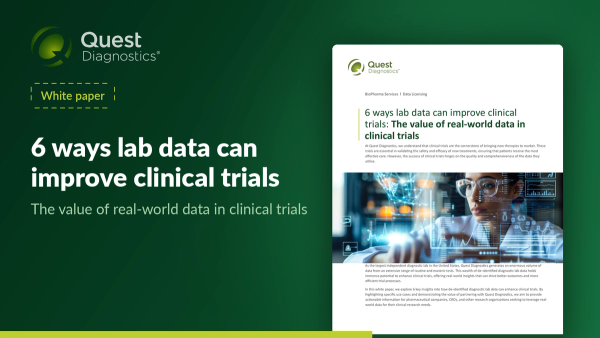
6 Ways Lab Data Can Improve Clinical Trials
Discover how Quest Diagnostics’ comprehensive lab data can elevate your clinical trials.
Latest Videos






Shorts
0:50
Building Trust in Clinical Trials: A Key Dimension for Success
20 days ago
by
Andrea Valente(+1 more)

0:37
Why Patient Voice Matters in Clinical Trials
a month ago
by
Amélie Lothe(+1 more)
0:45
Embedding Diversity into Clinical Research
5 months ago
by
Adrelia Allen
1:27
ACT Ops Take: Modernizing Participant Payments for Clinical Trial Success
6 months ago
by
Andy Studna, Senior Editor
0:58
Can AI Predict Health Issues?
6 months ago
by
Mohammed Saeed, MD, PhD(+1 more)
0:34
What 'Authentic Community Engagement' Actually Means
6 months ago
by
Del Smith, PhD(+1 more)
0:45
Why the Shift to Patient-Centric Clinical Trials is Crucial
8 months ago
by
Miriam Dervan

0:58
Can AI Predict Patient Success in Clinical Trials?
10 months ago
by
Dominique Demolle(+1 more)
0:36
A Time for Change: Clinical Trials Must Become a Care Option
a year ago
by
Iddo Peleg (+1 more)
0:33
How a Unified Trial Platform Can Change Patient Care
a year ago
by
Adrianne Rivard(+1 more)
Advertisement
More News
Advertisement

Cell and gene therapy access expands into community care settings only when operational coordination, site readiness, and supply chain standardization become first-order priorities equivalent to manufacturing capacity, requiring standardized processes, digital integration, and distributed logistics networks.

Decentralized trial models have demonstrated real gains in enrollment performance and patient access, but operational switching costs, fragmented technology stacks, and unresolved gaps in the patient-site relationship raise a question the industry has been slow to confront directly.

The clinical research industry talks about patient-centeredness constantly but embeds it too late, too narrowly, and without clear ownership, and the cost shows up in enrollment failures, protocol deviations, and outcomes that don't reflect what patients actually care about.

Regulatory expectations for patient input in drug development have shifted from aspiration to documented methodology across three major jurisdictions.

Participant engagement depends more on clarity and understanding than on gamification or incentives, requiring engagement embedded into trial workflows as a core design component rather than a peripheral consideration

Beyond Compliance: NetraMark's Joseph Geraci, PhD, on Making AI-Driven Patient Subgroups Explainable
In this episode of Beyond Compliance, Otis Johnson, PhD, MPA, founder and principal consultant at Vantix Operations, speaks with Joseph Geraci, PhD, co-founder and chief scientific and technical officer at NetraMark, about why explainable AI, not black-box prediction, is needed to reveal clinically meaningful patient subgroups in regulated drug development.

Patient-centricity remains largely consultative in most clinical research, yet rare disease communities demonstrate that genuine partnership from protocol inception improves feasibility, reduces unnecessary burden, and identifies outcomes that matter to patients themselves.

Static budgeting models and one-size-fits-all fair market value approaches create visibility gaps around inflation and true site costs, but regional frameworks, standardized costing toolkits, and accountability metrics can rebuild trust and replace defensive negotiations with transparency.
Biomarker-informed trial enrollment appears straightforward for identifying responders and optimizing efficiency, but failures to account for demographic variation in cut-off selection, causality versus correlation, and composite biomarker complexity risk excluding viable patients and exacerbating disparities.

From point-of-care sample collection to real-world data curation, wearable device integration, and continuous review infrastructure, data quality is not a single problem in clinical trials—it is a layered challenge that manifests differently at every stage of development and demands a different set of solutions at each one.
Advertisement

Under-enrollment isn't news to teams running oncology trials, and the instinct is to spend more on reach. The evidence, however, says the biggest leak is something else entirely and that most recruitment budgets focus on the least valuable part of the problem.
Consumer-grade wearables offer promise for reducing trial burden and improving engagement, but accuracy and reliability vary substantially by device, measurement, and population, requiring rigorous fit-for-purpose validation and careful endpoint selection before integration into regulated research.

Sponsored
A sponsor faced recruitment roadblocks for a Phase II oncology clinical trial. The solution: Citeline PatientMatch, leveraging RWD and natural language processing for optimal site and patient selection.

Sponsored
A sponsor faced recruitment roadblocks for a Phase II oncology clinical trial. The solution: Citeline PatientMatch, leveraging RWD and natural language processing for optimal site and patient selection.
Sponsored
Small patient pools, strict I/E criteria, and delayed diagnosis plague rare disease recruitment. Alerting patients about trials, seeking their input, and building trust are ways to boost recruitment.

Sponsored
Recruitment is moving from site-first to patient-first models. Gain insights into the role RWD plays, data-driven patient identification, and overcoming bottlenecks with more targeted strategies.

In this Q&A, Rob DiCicco, vice president of portfolio management at TransCelerate Biopharma, discusses the collaborative work underway with FDA and CTTI to explore selective safety data collection as a model for de-risking trial design, reducing site and patient burden, and scaling pragmatic trial approaches across the industry.

The evolving role of medical affairs in connecting patients, physicians, and evidence generation.
Eligibility criteria alone rarely predict enrollment, which depends more on trust, hope, and fear, requiring relationship-based community engagement paired with behavioral readiness assessments rather than transactional outreach.

In this Q&A, Liz Beatty, co-founder and chief strategy officer at Inato, discusses how real-time patient data is reducing non-enrolling sites, why sponsor-specific technology remains the biggest barrier to adoption, and what a shift toward cross-asset site partnerships could mean for enrollment efficiency.

When clinical trial teams screen for "tech-savvy, engaged" participants, they're often running a second, unwritten eligibility criterion that systematically excludes the populations the study drug is actually meant to treat.

From real-time evidence generation to federated AI to site-level data integration, ACT spoke with seven experts at DIA 2026 on the trends and challenges defining clinical trial operations today.

In this video interview from the 2026 DIA Global Annual Meeting, Stacy Hurt, chief patient officer at Parexel, explains how federated AI is expanding what's possible in oncology research, why the patient voice gets lost earliest in development, and why someone in every organization needs to explicitly own patient needs from the very beginning.
Outdated payment methods like prepaid cards and checks create administrative burden and retention friction, but modern flexible payment platforms with multiple payout options and global reach can improve participant experience without adding compliance complexity.

From planning one Phase III trial at a time to digital standardization on repeat.
Advertisement
Advertisement
Trending on Applied Clinical Trials Online
1
Beyond Outreach: Structural Drivers of Representation in Clinical Trials
2
Flexible Clinical Operations and Site Management Across a Diversified Biotech Portfolio: An Application of Quality by Design and Risk-Based Oversight
3
AI and Patient Recruitment: Can Predictive Promise Drive True Transformation?
4
The Test Is the Ticket: Building Smarter Pathways to Clinical Trial Participation
5