
“It is the ability to maintain scientific integrity and hit targets even when real-world outcomes deviate from the protocol’s assumptions. By modeling a wide range of scenarios during the planning phase, sponsors can build flexibility into their designs to ensure the trial remains viable even when the biological or clinical reality shifts away from early estimates.”
Commentary|Articles|February 2, 2026
De-Risking Development: Prioritizing Robustness in Trial Design
Author(s)Elad Berkman
Listen
0:00 / 0:00
When a single pivotal trial can determine the fate of an entire program, success depends less on marginal gains in speed or cost and more on building robust, adaptive trial designs that actively manage uncertainty and protect the probability of a positive outcome.
Advertisement
Biopharma sponsors are conditioned to chase two metrics above all: speed and cost.In the race to market, every effort is poured into shortening trial durations and optimizing sample size.
When applied across a global portfolio, a 20% to 40% reduction in costs or time is extremely significant. But if you zoom in on a single, make-or-break trial, especially for a biotech or focused pharma team, the stakes are different.
The priority shifts from improving efficiency to ensuring success. When success is mission critical and missing that primary endpoint means the whole program stops, saving a percentage of costs or cutting a few dozen patients is not the priority.
The budget is already set. The goal is not to marginally improve statistical power, but to fundamentally de-risk the program to secure a positive outcome.
The Unforeseen Threat: Uncertainty in Drug Development
The core challenge in drug development is the inherent uncertainty, much of which remains uncharacterized until the program is actually underway. Clinical trials are subject to multiple real-world variables, including varying site competence, patient data variability, changes in the standard of care and fundamental uncertainties about the drug's effect size.
When success is paramount, the solution is to actively design the trial to handle this unpredictability. This is precisely where robustness in clinical trial design becomes essential.
The Hidden Risk of Conservative Trial Design
Biopharma sponsors often select sites or designs based on past experiences that suggest a high probability of success. However, if those experiences do not account for underlying uncertainty, the entire program is potentially exposed to unnecessary risk.
The danger extends beyond operational challenges such as site underperformance to the risk that initial assumptions about effect size or patient response were misaligned with reality from the start.
In traditional fixed trials, the study design is locked prior to the enrollment of the first patient, with parameters such as sample size and primary endpoints remaining unchanged. However, if the observed treatment effect differs from the baseline assumptions, this rigid approach can lead to trial failure.
This is not because the therapy lacks potential, but because the design lacks the mechanisms to adapt to emerging data. In a trial setting, robustness means more than managing operational variability.
It is the ability to maintain scientific integrity and hit targets even when real-world outcomes deviate from the protocol’s assumptions. By modeling a wide range of scenarios during the planning phase, sponsors can build flexibility into their designs to ensure the trial remains viable even when the biological or clinical reality shifts away from early estimates.
Adaptive Design: Turning Robustness into Action
With advanced analytics, AI, and machine learning, this robustness is no longer just theory. We can now incorporate it directly into the trial protocol using adaptive designs. These practical tools move away from a fixed plan and instead adapt to the signals the data sends.
- Sample Size Re-estimation (SSR): This is a powerful safety net. If the mid-trial data suggests the treatment effect is different from your initial hypothesis, SSR lets you pre-plan an adjustment to the patient numbers needed to maintain high statistical power. It stops you from running an underpowered study that's likely to fail or an unnecessarily bloated one.
- Enrichment Designs: In cases for which there is potential for substantial treatment heterogeneity, an enrichment design lets you take an early look at the data to focus on the most responsive subpopulation, such as patients with a specific biomarker. You can then focus all subsequent recruitment solely on that group, significantly improving the chance of a positive outcome.
- Group Sequential Designs: These allow for pre-planned checkpoints to stop a trial early if the drug is clearly working or clearly failing. Stopping for futility saves millions in wasted resources, while in multiarm trials, it allows you to drop less effective candidates and focus all resources on the best performers.
Beyond the design, if enrollment slows due to seasonal effects or difficulty finding a niche patient group, a robust design activates a contingency plan that dynamically adjusts site selection based on real-time enrollment data. It ensures you still hit your required statistical power targets, even when the initial forecasts are off.
Focus on What Matters
Efficiency matters, and sponsors will keep pursuing it. But when it comes to the success of a single program, maximizing the probability of a positive outcome is the ultimate priority.
For effective clinical development in 2026 and beyond, we must leverage advanced analytical methods, including sophisticated simulation and design optimization before a trial begins, all the way through to real-time monitoring.
By anticipating and actively designing for the unexpected, sponsors can de-risk their programs and significantly speed up the delivery of promising new therapies to the patients who need them.
About the Author
Elad Berkman is co-founder and CTO of
Advertisement
Related to this article

Clinical trial endpoints define what success looks like, but patients and caregivers are rarely the ones setting that definition, and the gap between what trials measure and what patients actually value is showing up in post-approval evidence, regulatory submissions, and the design rooms where protocols are written.

In this video interview, Rajneesh Patil, global head of AI, digital, and innovation in clinical development at Syneos Health, argues that CROs must act as orchestrators rather than aggregators—and that the real test of any AI ecosystem is whether it reduces sponsor coordination burden or just hands it back to them.

AstraZeneca and Oracle Outline AI Collaboration for Clinical Trial Recruitment and Safety Monitoring
What sponsors and sites should know about the AstraZeneca-Oracle AI collaboration on trial recruitment, safety monitoring and data governance.
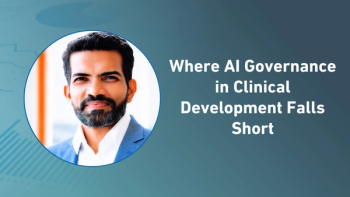
In this video interview, Rajneesh Patil, global head of AI, digital, and innovation in clinical development at Syneos Health, identifies three recurring failure modes in AI governance frameworks—and explains why responsible AI must be an ongoing operating discipline, not a one-time approval gate.

In this video interview, Rajneesh Patil, global head of AI, digital, and innovation in clinical development at Syneos Health, explains why the shift from narrow AI tools to a continuous learning clinical operating system is where the real operational value lies—and what it takes to get there.

In this Q&A, Saamir Pasha and Carole Berini, PhD, of Ontada discuss what it takes to harmonize fragmented oncology data into reliable real-world evidence, how lab markers can proxy for missing functional status data, and where the biggest remaining barriers to consistent RWE generation lie.

Real-time clinical trials require standardized digital data capture at the point of care through scaled eSource-EDC-EHR integration, but progress stalls because competing standards lack regulatory enforcement and one-off system integrations cannot scale beyond single studies without industry-wide alignment and legal clarity on data ownership.

AI can turn complex protocols into first-pass budget inputs, letting sponsors start budgeting sooner while budget builders shift from data entry to review.
Advertisement
Advertisement
Trending on Applied Clinical Trials Online
1
Where the Industry Is Headed as Clinical, Operational, and Real-World Data Connect
2
Building Standardized Evidence for eSource-Enabled Clinical Trials: Multi-Site Validation of a Clinical Research Coordinator Satisfaction Methodology
3
Where AI Governance in Clinical Development Falls Short
4
Syneos Health, Optum Partner on Adaptive Clinical Development Model
5