
"Faster IND pathways, real-time review, and AI-enabled decision support could all make the country a more welcoming location to run trials.”
News|Articles|October 1, 2026
HHS Launches SURPASS Program and Three Complementary Initiatives to Transform Clinical Trial Design and Infrastructure
Author(s)Andy Studna, Senior Editor
Listen
0:00 / 0:00
Key Takeaways
- SURPASS combines simulation, real-time analytics, and operational automation to enable seamless adaptive trials that generate higher-quality evidence faster and with reduced execution burden.
- STACK uses AI to accelerate site activation and expand US trial capacity by converting research-naive locations into functional clinical trial sites.
The new effort combines adaptive platform trial design, AI-enabled site activation, nationwide data infrastructure, and patient data contribution tools to reduce timelines, costs, and patient burden across clinical development.
Advertisement
The Advanced Research Projects Agency for Health (ARPA-H), operating under the Department of Health and Human Services (HHS), has launched the Simulation-augmented, Real-time Platform Adaptive Seamless Trials (SURPASS) program alongside three complementary projects aimed at modernizing how clinical trials are designed and conducted in the United States.1
The announcement, made September 30, advances the Trump administration's broader effort to reduce clinical development timelines and strengthen US competitiveness in biotechnology and drug development.
Clinical drug and biologic development currently takes more than a decade on average, costs up to $2 billion, and fails more than 90% of the time, according to ARPA-H. The agency frames those numbers not only as a scientific and economic problem but as a patient access problem: promising treatments either take too long to reach people who need them or are never developed because the economics do not work.
SURPASS is designed to address the trial design layer of that challenge. The program will pursue three coordinated technical areas: a phaseless design engine that integrates digital twins and predictive models into trial design to simulate outcomes before launch; a continuous inference engine that enables real-time or on-demand analysis and supports rapid trial adaptations; and an agentic operations layer that automates key startup and operational activities including data collection, cleaning, and dataset construction.
"SURPASS is developing the technology and biostatistical frameworks needed to analyze trial data as it accumulates, allowing teams to learn in real time, adapt when needed, and generate stronger evidence faster with less operational burden," said SURPASS Program Manager Daria Fedyukina, PhD, in an HHS press release.
Three complementary projects targeting infrastructure gaps
Alongside SURPASS, ARPA-H announced three projects targeting the operational and infrastructure barriers that slow trials even when study design is sound.
STACK will focus on expanding domestic clinical site capacity, using artificial intelligence to accelerate site activation and convert research-naive sites into functional clinical trial sites.
COMMONS will build privacy-by-design data architecture capable of enabling consent at national scale and providing access to regulatory-grade data for enrollment, predictive modeling, and broader modernization efforts.
CINCH will focus on the patient side, aiming to help patients contribute their own real-world data, support continuity of care, and connect more quickly to trials that may be appropriate for them.
"Clinical trials are often slowed not just by study design, but by operational barriers like site activation, fragmented data access, and a patient experience that can often be very burdensome for patients and their caregivers," Fedyukina added. "STACK and COMMONS are designed to tackle those barriers directly so that more patients can connect to trials and more trials can run efficiently in the United States."
The broader context
The SURPASS launch is the latest in a series of HHS and FDA actions taken following the announcement of Operation TrialBlazer, the department-wide initiative announced earlier this year to restore US leadership in clinical research.2
Operation TrialBlazer encompassed FDA actions on early development, including the Expedited IND Pilot and updated Chemistry, Manufacturing, and Controls (CMC) requirements for Phase I submissions, as well as late-stage guidance clarifying that a single rigorous pivotal trial with confirmatory evidence can support drug approval in many cases.
Industry reaction to those earlier efforts has welcomed the direction while flagging that regulatory reform alone will not close the gap. In a earlier Q&A with Applied Clinical Trials, Richard Graham, PhD, co-founder and chairman of the board at TruTechnologies, alluded to what SURPASS is now trying to address at the infrastructure level.3
"Faster IND pathways, real-time review, and AI-enabled decision support could all make the country a more welcoming location to run trials," Graham said. "However, none of this will truly move the needle if we don't fix how trial data is collected, monitored, and made trustworthy as a clinical trial is executed day-to-day. Data can't continue to be captured late, cleaned up after the fact, or looked at only when problems have already occurred. If any newly introduced policies and technologies are built on top of current practices, we've just created a faster road to the same exact broken bridge.”
SURPASS and its companion projects are positioned as the infrastructure response to exactly that critique. Whether they deliver on it will depend on adoption, regulatory confidence in the new methods, and how quickly the tools move from demonstration to standard practice.
References
- HHS Launches SURPASS and New Efforts to Accelerate Faster, Smarter Clinical Trials. HHS. September 30, 2026.
https://www.hhs.gov/press-room/hhs-arpa-h-launch-surpass-modernize-clinical-trials.html - HHS Launches Operation TrialBlazer to Restore US Leadership in Clinical Research. Applied Clinical Trials. June 23, 2026.
https://www.appliedclinicaltrialsonline.com/view/hhs-operation-trialblazer-us-leadership-clinical-research - Why Clinical Trial Modernization Fails Without Point-of-Care Data: Q&A with Richard Graham, PhD, TruTechnologies. Applied Clinical Trials. August 10, 2026.
https://www.appliedclinicaltrialsonline.com/view/clinical-trial-modernization-fails-point-of-care-data-richard-graham-phd-trutechnologies
Advertisement
Related to this article

In this Q&A, Saamir Pasha and Carole Berini, PhD, of Ontada discuss what it takes to harmonize fragmented oncology data into reliable real-world evidence, how lab markers can proxy for missing functional status data, and where the biggest remaining barriers to consistent RWE generation lie.

Clinical trial endpoints define what success looks like, but patients and caregivers are rarely the ones setting that definition, and the gap between what trials measure and what patients actually value is showing up in post-approval evidence, regulatory submissions, and the design rooms where protocols are written.

A new white paper and public engagement process outline the FDA’s commitment to building fit-for-purpose evidentiary standards, stronger patient voice integration, and greater regulatory predictability across rare disease drug development and review.

Real-time clinical trials require standardized digital data capture at the point of care through scaled eSource-EDC-EHR integration, but progress stalls because competing standards lack regulatory enforcement and one-off system integrations cannot scale beyond single studies without industry-wide alignment and legal clarity on data ownership.
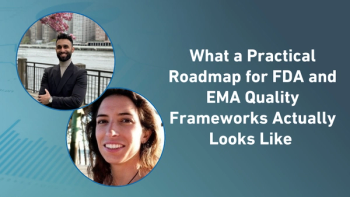
In this video interview, Saamir Pasha and Carole Berini, PhD, of Ontada, describe what operationalizing regulatory-grade quality frameworks requires—and why fit-for-purpose evidence generation is a transparency and documentation discipline, not just a data cleanliness exercise.

Real-time RBQM requires proportionate analysis frequency matched to data arrival and issue criticality, not continuous reanalysis, because signal churn from over-frequent runs creates alert fatigue and operational noise that obscures meaningful deterioration.

Pacing obesity trial enrollment, anchoring eligibility to stable real-world therapies, and building site and physician relationships improve retention and data quality more than aggressive recruitment or restrictive exclusion criteria do.

In this video interview, Rajneesh Patil, global head of AI, digital, and innovation in clinical development at Syneos Health, argues that CROs must act as orchestrators rather than aggregators—and that the real test of any AI ecosystem is whether it reduces sponsor coordination burden or just hands it back to them.
Advertisement
Advertisement
Trending on Applied Clinical Trials Online
1
Syneos Health, Optum Partner on Adaptive Clinical Development Model
2
Where AI Governance in Clinical Development Falls Short
3
AstraZeneca and Oracle Outline AI Collaboration for Clinical Trial Recruitment and Safety Monitoring
4
2026 SCRS Global Site Solutions Summit: What's the Biggest Mistake Sites or Sponsors Make When Implementing Advanced Al?
5