Commentary|Articles|November 19, 2026
How AI-Enabled Trial Matching Can Close the Oncology Access Gap: Q&A with Shaalan Beg, MD, MBA, FASCO, ConcertAI
In this Q&A, Shaalan Beg, MD, MBA, FASCO, chief medical officer at ConcertAI, discusses why so many patients from underrepresented groups are never asked to join a clinical trial, how AI-enabled matching and screening can make oncology access more consistent, and why the conversation with the patient must stay human.
Advertisement
Advertisement
Who gets offered a clinical trial in oncology still depends heavily on geography, site resources, and whether a busy physician happens to remember that a study is an option. Once a trial is offered, however, acceptance rates look the same across racial and ethnic groups, which points to access and screening, not patient willingness, as the real gap.
Related to this article

In this Q&A, Kent Thoelke, CEO of Paradigm Health, discusses why participation gaps in community and rural settings come down to both patient cost barriers and site infrastructure, how legacy workflows weigh on community clinics, and what policy and technology changes it would take to make clinical research a real care option for more patients.

Participants in a survey of 354 pre-screening respondents rated AI voice-assisted screening (Clara) favorably and were more likely to schedule and attend study appointments than web-form users, though self-selection means the association cannot be read as causal.

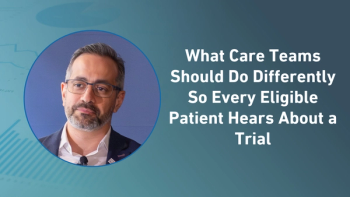
In this video interview, Shaalan Beg, MD, MBA, FASCO, chief medical officer at ConcertAI, describes how physician awareness and site-level access drive screening inconsistencies, and why acceptance rates are the same across backgrounds once patients are simply asked.

Community participation gaps look less like a question of patient willingness and more like a financing and infrastructure problem that no single bill has yet solved.

In this video interview, Shaalan Beg, MD, MBA, FASCO, chief medical officer at ConcertAI, outlines how integrating trial matching with standard of care workflows and uniform screening can replace reliance on physician memory with timely, consistent nudges.

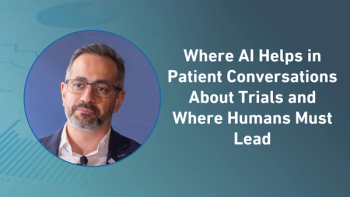
In this video interview, Shaalan Beg, MD, MBA, FASCO, chief medical officer at ConcertAI, makes the case that oncologists must lead discussions about randomization and treatment decisions, while AI can prepare patients beforehand and support them afterward.

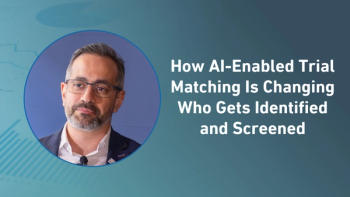
In this video interview, Shaalan Beg, MD, MBA, FASCO, chief medical officer at ConcertAI, explains how AI can unlock unstructured chart data and cut coordinator screening time from hours to minutes, easing a clinical research workforce under strain.
Advertisement
Advertisement