
News|Podcasts|January 12, 2026
ACT Brief: Trial Competition Slows AI Gains, Rethinking Patient-Level Safety Decisions, and What Separates Real AI Platforms in Clinical Trials
Author(s)Andy Studna, Senior Editor
In today’s ACT Brief, we look at how growing trial competition is undermining AI-driven efficiency gains, why pharmacovigilance is shifting toward patient-level causal reasoning, and what AI life sciences companies must demonstrate to stand out in a crowded market.
This is the Applied Clinical Trials Brief—your fast track to the latest insights shaping clinical operations and drug development.
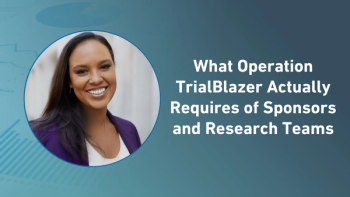
- In part two of an Applied Clinical Trials interview, Liz Beatty, co-founder and chief strategy officer at Inato,
said AI is already delivering efficiency gains across protocol design, site feasibility, and trial operations, but those gains are increasingly offset by growing trial competition. Beatty noted that sponsors continue to rely on the same small pool of high-profile sites, creating congestion that slows startup and enrollment, and said broader, more diversified site strategies are needed for AI-driven efficiencies to translate into faster trial completion and patient access. - A new contributor article
outlines why pharmacovigilance tools built for population-level signal detection fall short when real-world safety decisions hinge on individual patients. The article argues for structured patient-level causal attribution to assess proportional contributions of multiple risk factors, moving beyond qualitative labels like “possible” or “probable,” and positioning individual-level reasoning as a downstream complement to existing PV systems rather than a replacement. - In a Pharmaceutical Executive interview, Angela Schwab, CEO of Trialynx,
said AI life sciences companies that stand out are those combining deep domain expertise with structured, step-by-step processes rather than generic AI wrappers. Schwab said AI is enabling a new era of clinical trial design by reducing manual protocol development, improving endpoint selection, and lowering failure rates through better upfront planning that reduces patient and site burden without weakening scientific rigor.
That’s all for today’s ACT Brief. Join us tomorrow for more updates shaping clinical operations and drug development. Thanks for listening.
Related Content



Trending on Applied Clinical Trials Online
1
The CRA of the Future: From Monitoring Activity to Strategic Site Partnership
2
ACT Brief: Data Quality as Foundational to Trial Modernization, CRAs Evolving to Strategic Site Partners, and 2026 Emerging Pharma Leaders Announced
3
Survey Finds US Biotechs Prefer Domestic First-in-Human Trials but FDA Hurdles Are Pushing Them Abroad
4
Closing the Dead Time Gap in Clinical Data: Q&A with Raviv Pryluk, PhaseV
5