






eClinical
Latest News
Advertisement
Latest Videos



Advertisement
More News
Advertisement

As clinical trials grow more complex, the technology infrastructure supporting them is under renewed scrutiny. Across data validation, AI adoption, and site-based systems, 2026 is shaping up as a year of implementation rather than experimentation.
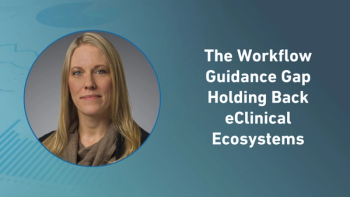
In this video interview, Cheryl Kole, vice president of solution strategy and commercialization at Almac Clinical Technologies, examines why current eClinical technology too often prioritizes data flow over the day-to-day needs of users and what a truly guided workflow experience should look like for busy site teams.

Moving beyond vendor evaluation to incentive design in Phase II/III rare and genetic disease trials.

Why rigorous testing and validation matter more than ever.

Public-private collaboration and structured evidence consolidation are emerging as critical enablers of regulatory-ready digital end points, helping standardize terminology, reduce duplication, and accelerate the integration of digital health technologies into clinical research and decision-making.
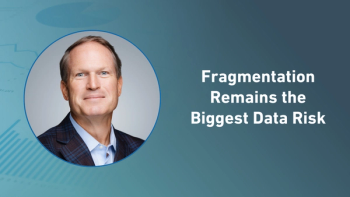
Jonathan Andrus, co-CEO of CRIO, outlines how disconnected systems and inconsistent data collection across sites create risk, while centralized eSource approaches present a major opportunity.

Insights from SCOPE 2026 highlight the industry’s shift toward connected, data-centric clinical trial ecosystems, where digital protocols, shared data, and renewed scientific rigor are driving more efficient, interoperable, and patient-focused research.
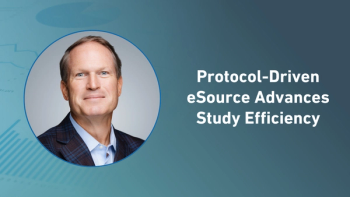
Jonathan Andrus, co-CEO of CRIO, explains how protocol-driven eSource templates and standardized data capture are improving consistency, oversight, and efficiency across clinical trial sites.

As eSource adoption expands, industry leaders are confronting new questions around AI oversight, unstructured data activation, institutional readiness, and regulatory trust. Here’s how experts say the next phase will unfold.
Mike Wenger, chief innovation officer at CRIO, explains how AI can responsibly support data quality and monitoring with proper oversight, and why advancing eSource and EHR systems remains critical to strengthening data integrity and remote trial operations.
Advertisement

Jeremy Wyatt, CEO, Ametris, discusses how operational best practices for integrating wearables into oncology trials center on minimizing patient burden through thoughtful workflow design, careful device selection, and early planning to ensure digital measures fit the realities of complex patient populations.

Mike Wenger, chief innovation officer at CRIO, discusses how different site types—from academic medical centers to independent research sites—require distinct eSource approaches, and why aligning technology with site workflows is critical to study execution.

Global clinical development has evolved into a technology-enabled, highly regulated, and geographically diversified enterprise, as sponsors adapt trial design, partnerships, and operations to meet rising demands for scale, speed, and patient-centricity.
Persistent delays and inefficiencies in COA licensing and translation stem from limited pre-license access and fragmented processes, making a strong case for providing outcome assessment measures earlier to reduce risk and accelerate trial start-up.
New research finds that while eSource adoption is advancing through EHR-to-EDC workflows, scaling its impact will depend on integrating unstructured clinical data using AI, shared standards, and collaborative validation models across sites, sponsors, and vendors.
What Patients Want From Remote Trials: New Survey Data Reveals Preferences Around Usability, Trust, and Participation
ByJiang Li
New survey data show a strong patient preference for fully remote clinical trials, underscoring how convenience, intuitive technology, and FDA-cleared digital tools are reshaping enrollment and retention strategies as decentralized models become a lasting fixture in clinical research.
New data show that applying AI to the migration of translated COAs into eCOA platforms can meaningfully reduce errors, accelerate localization workflows, and support broader global patient participation—while still relying on human reviewers to ensure linguistic precision and clinical integrity.

Strong relational governance between technology vendors and sponsor–CRO teams is becoming a critical foundation for eCOA trial success, enabling faster study launches, clearer communication, proactive issue management, and sustained quality across entire trial portfolios.
AI-driven discovery, EHR-based real-world evidence, and synthetic patient modeling are rapidly reshaping drug repurposing, reducing development timelines, expanding therapeutic applications, and accelerating regulatory acceptance of computational approaches.

As clinical trials become more complex and decentralized, the role of the CRA is evolving from site monitor to strategic, digitally fluent partner, requiring expertise in hybrid oversight, risk-based monitoring, and multi-system data management.
As decentralized and hybrid trial models expand, eConsent is emerging as a critical tool for improving participant understanding, reducing site burden, and strengthening data integrity through digital automation, accessibility, and regulatory compliance.
Gain perspective on how agentic AI can bridge eCOA, EDC, IRT, and CTMS platforms to reduce manual effort and improve operational efficiency.

The convergence of AI, decentralized technologies, behavioral science, and real-world evidence opens the door to a new era in which the clinical trial industry proactively addresses participation barriers, integrates social determinants of health, and reimagines patient centricity.

As clinical research becomes increasingly digital, integrating rigorous cybersecurity assessments into CRO selection and qualification is essential to safeguard sensitive data and ensure trial integrity.

New guidance and technology advances are reshaping eClinical systems, positioning them as tools to accelerate enrollment, improve data quality, and reduce site and patient burden.
Advertisement
Advertisement
Trending on Applied Clinical Trials Online
1
Real-Time Clinical Trials Depend on a Scalable EHR-to-EDC Connection
2
What It Actually Means to Embed AI Across the Clinical Operating Model
3
FDA Launches Rare Disease Framework Initiative to Reimagine Drug Development for Small Patient Populations
4
Real-World Oncology Data: From Treatment Patterns to Novel Therapies
5