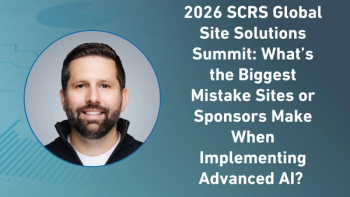
CRIO’s chief innovation officer, Mike Wenger touches on the two ways sites get AI adoption wrong.
CRIO’s Mike Wenger, speaker at this year's SCRS summit, maps how sites are actually deploying AI post-pilot stage.
Mike Wenger, chief innovation officer, CRIO, breaks down how sites are actually using AI once implementation moves past the pilot stage, noting the term itself is loaded and covers approaches with very different risk profiles.
Wenger says some sites work directly with vendors whose products have built-in AI capabilities, or engage newer startups offering genuinely novel functionality made possible by AI, a category he treats as its own separate conversation.
A second, increasingly common pattern involves sites not waiting on vendors at all, instead taking matters into their own hands using tools like Claude Code and other AI engineering tools to write software themselves, despite not being trained developers. Wenger describes the results as impressive, producing solutions custom-fit to a specific organization’s needs. However, he cautions that this approach carries real risk when applied to core, regulated systems of record, such as CTMS, eSource, or eReg platforms governed by 21 CFR Part 11, where system downtime or data security failures would be serious. He contrasts this with lower-stakes applications, like onboarding new staff or standardizing resume templates across a roster of 100 PIs, where AI offers meaningful time savings with a comparatively low risk profile.
At the other end of the spectrum, Wenger points to sites giving staff direct access to AI and foundational models through enterprise tools like enterprise ChatGPT or enterprise Claude. He describes this as powerful due to its flexibility and openness, but notes it requires proper training and safeguards to ensure staff handle confidentiality and PHI appropriately when using these open-ended tools.