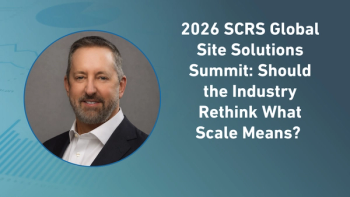
Paradigm’s Kurt Mussina discusses why scale should drive operational efficiency, not consolidation into single-site studies.
Paradigm’s Kurt Mussina touches on why he rejects the “site management organization” model in favor of one unified business.
Kurt Mussina, CEO, Paradigm Clinical Research, describes his organization’s nine locations not as separately managed sites, but as a single business operating under one fully integrated structure, sharing the same SOPs and one management team.
He deliberately distances this model from the “site management organization” label, explaining that he doesn’t see himself as managing a collection of independent sites but running one unified business with multiple locations. In his view, attempting to centrally manage what is essentially a group of distinct, independent businesses introduces challenges that a truly integrated model avoids, though he’s careful to frame this as a difference in approach rather than a claim of superiority.
That same emphasis on infrastructure over isolated credentials carries into how Mussina believes sponsors and CROs should vet multi-site organizations. He acknowledges that PI experience is a natural and important first question, but argues it’s incomplete without a follow-up: what does the support system surrounding that PI actually look like, and does that system itself have a track record of performing well?
At Paradigm, this includes sub-investigators on payroll along with coordinators and research assistants, an entire ecosystem he considers as important, if not more important, than the PI’s individual experience. He adds that experience alone doesn’t capture turnover, noting that a strong historical performance on a particular study type means little if the people responsible for it are no longer with the organization. Since clinical research is fundamentally a people business, Mussina argues that evaluating real, executable capacity requires looking beyond the PI to the stability and performance of the full support system around them.