Register Now: Beyond EDC: Designing a Connected Data Strategy for Predictive Clinical Development
News|Articles|June 26, 2026

6 Ways Lab Data Can Improve Clinical Trials

Key Takeaways

  • Quest Diagnostics highlights comprehensive lab data as a real-world evidence source that can elevate clinical trials across multiple phases of the trial process.
  • A new white paper enumerates six distinct ways laboratory data can be applied to improve trial planning, conduct, and interpretation.
SHOW MORE

Discover how Quest Diagnostics’ comprehensive lab data can elevate your clinical trials. Our latest white paper, "6 Ways Lab Data Can Improve Clinical Trials," explores the power of real-world data at every stage of the trial process.

Download Whitepaper


Related to this article

The Human Side of Clinical Trials: Why Fuzzy Mental Models Undermine Clinical Trial Execution
In Episode 3 of The Human Side of Clinical Trials, hosts Brian S. McGowan, PhD, FACEHP, chief learning officer and co-founder of ArcheMedX, Inc., and Kelly Ritch, chief operating officer of ArcheMedX, Inc., speak with Jason Riis, PhD, CEO and chief behavioral scientist at Behavioralize, about why a well-written protocol doesn’t always translate into consistent execution, and how designing for the way people actually think and learn can reduce site burden and the need for costly unlearning.
© photon_photo - © photon_photo - stock.adobe.com
Standardized measurement across five oncology centers found that clinical research coordinators rated eSource-enabled workflows positively (Overall Mean Satisfaction 5.79 of 7), with reduced manual entry and electronic data transfer earning strong marks, while perceived reduction in sponsor and monitor queries lagged as the one domain below threshold.
Where the Industry Is Headed as Clinical, Operational, and Real-World Data Connect
In this video interview, Rajneesh Patil, global head of AI, digital, and innovation in clinical development at Syneos Health, describes the industry’s trajectory toward a unified intelligence orchestration environment—and explains why the future isn’t one model that knows everything, but a trusted system that brings the right evidence to the right human decision.
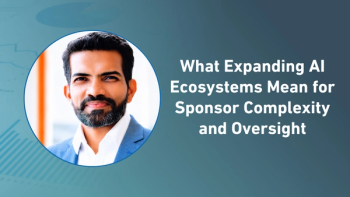
What Expanding AI Ecosystems Mean for Sponsor Complexity and Oversight
In this video interview, Rajneesh Patil, global head of AI, digital, and innovation in clinical development at Syneos Health, argues that CROs must act as orchestrators rather than aggregators—and that the real test of any AI ecosystem is whether it reduces sponsor coordination burden or just hands it back to them.