News|Slideshows|October 13, 2025

Applied Clinical Trials

  • Applied Clinical Trials-10-01-2025
  • Volume 34
  • Issue 4

Applied Clinical Trials' 2025 State of the Industry Survey

Capturing insights from clinical research professionals on the key trends and challenges shaping drug development today, from those in clinical trial operations and site relationships, to technology and AI, and the evolving regulatory and policy terrain.

Applied Clinical Trials recently conducted its State of the Industry survey, capturing perspectives on the current clinical research landscape and outlook for the future.

Related to this article

© putilov_denis - © putilov_denis - stock.adobe.com
Real-time clinical trials require standardized digital data capture at the point of care through scaled eSource-EDC-EHR integration, but progress stalls because competing standards lack regulatory enforcement and one-off system integrations cannot scale beyond single studies without industry-wide alignment and legal clarity on data ownership.

The Human Side of Clinical Trials: Why Fuzzy Mental Models Undermine Clinical Trial Execution
In Episode 3 of The Human Side of Clinical Trials, hosts Brian S. McGowan, PhD, FACEHP, chief learning officer and co-founder of ArcheMedX, Inc., and Kelly Ritch, chief operating officer of ArcheMedX, Inc., speak with Jason Riis, PhD, CEO and chief behavioral scientist at Behavioralize, about why a well-written protocol doesn’t always translate into consistent execution, and how designing for the way people actually think and learn can reduce site burden and the need for costly unlearning.
Better Site Training Starts With Five Simple Questions
Site training effectiveness depends on readiness at first-patient-in, requiring learning-science design principles around performance focus, cognitive load reduction, progressive sequencing, and spaced retrieval practice rather than training completion metrics or content volume.
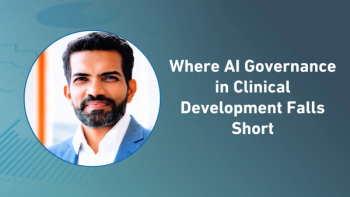
Where AI Governance in Clinical Development Falls Short
In this video interview, Rajneesh Patil, global head of AI, digital, and innovation in clinical development at Syneos Health, identifies three recurring failure modes in AI governance frameworks—and explains why responsible AI must be an ongoing operating discipline, not a one-time approval gate.