
“Many sponsors successfully operate hybrid models in which FSP manages specific functions (e.g., clinical monitoring) while FSO handles other domains. This blended approach provides operational flexibility without requiring complete outsourcing.”
Commentary|Articles|July 30, 2026
Tailoring Your FSP Approach: Why One Model Doesn’t Fit Every Trial
Author(s)Nicole Duffey
Listen
0:00 / 0:00
Key Takeaways
- Nearly 90% of sponsors utilize Functional Service Provider (FSP) or hybrid outsourcing models, yet misconceptions continue to limit strategic adoption.
- FSP should be viewed as a configurable continuum, not a replacement model requiring wholesale operational restructuring.
As clinical development grows increasingly complex and talent markets remain constrained, sponsors must evolve beyond binary outsourcing decisions to embrace a configurable functional service provider continuum that enhances operational optionality without requiring wholesale restructuring.
Advertisement
Clinical development is at an inflection point. Sponsors face mounting pressures such as constrained resourcing capacity, workforce volatility, increased regulatory scrutiny, and escalating development costs.
However, many organizations still default to traditional structures without evaluating how a more configurable functional service provider (FSP) approach could better fit their needs.
For years, the outsourcing decision was binary: build internal capacity or engage a full-service provider (FSO); however, today's clinical environment demands more sophistication.
Most sponsors now utilize FSP or hybrid outsourcing models across portions of their portfolios. Yet hesitation persists, often rooted in persistent misconceptions about what FSP truly requires and how it fits within existing operational structures.
It's time to reframe the conversation.
The misconception problem
FSP should not be viewed as a replacement model that requires wholesale operational restructuring. Rather, it represents a configurable continuum.
A spectrum of engagement models that can be tailored to specific functional needs, organizational maturity, and strategic objectives. Yet, three persistent misconceptions continue to constrain adoption.
First, many assume that FSP requires fully developed standard operating procedures (SOPs), robust governance systems, and mature internal management infrastructure. In reality, FSP partnerships often mitigate infrastructure gaps rather than depend on their prior existence.
Emerging biopharma organizations and mid-sized sponsors have successfully deployed FSP to provide scalable dedicated resources to fill talent gaps without first building comprehensive internal systems.
Second, organizations believe FSP and full-service outsourcing are mutually exclusive—an either/or choice. But this is false.
Many sponsors successfully operate hybrid models in which FSP manages specific functions (e.g., clinical monitoring) while FSO handles other domains. This blended approach provides operational flexibility without requiring complete outsourcing.
Third, FSP is often misunderstood as temporary contractor staffing dressed up with a new label. In practice, FSP arrangements can be structured to include clear functional ownership and accountability for outcomes.
It may include dedicated resources, but the key distinctions lie in governance structure, performance metrics, and management responsibility—elements that can be tailored depending on the sponsor’s needs and internal capabilities.
The FSP continuum framework
Outsourcing models exist along a spectrum. At one end is full-service outsourcing, where an external partner assumes comprehensive responsibility at the trial level.
At the other is fully insourced operations. Between these poles lie multiple configurations: single- or multi-service modular outsourcing, hybrid or blended models, embedded FSP support, and full functional carve-out under FSP management.
Within the FSP spectrum itself, maturity ranges from tactical embedded support (providing supplemental resources within existing internal structure) to full functional management (external partner assumes accountability for outcomes). Understanding this gradation is critical.
FSP is not a singular structure, but an adaptable framework capable of aligning with varying sponsor needs and strategic priorities.
Real-world applications
Consider a mid-sized biotech firm conducting three Phase II trials simultaneously. Constrained internal monitoring capacity created bottleneck risk. Rather than hiring permanent staff or engage full-service outsourcing for all three studies, the sponsor deployed FSP to manage monitoring operations for two studies while maintaining internal control over the third.
This blended approach provided capacity relief, maintained strategic oversight, and avoided long-term permanent headcount costs. In another example, an emerging biopharma organization lacked mature regulatory infrastructure but needed to accelerate timelines.
FSP engagement provided dedicated monitoring professionals, established processes, and governance oversight, effectively building capacity without requiring internal hire-ups. Within 18 months, as internal capabilities matured, the FSP engagement transitioned to a lighter advisory model, demonstrating FSP's flexibility across an organization's lifecycle.
Strategic decision-making
Deploying FSP strategically requires an honest assessment of three dimensions: functional complexity, internal capacity maturity, and strategic priority.
The question is no longer, "Should we use FSP?" Most sponsors already have. The relevant question is, "How do we strategically configure FSP to optimize operational performance, reduce risk, and enhance flexibility?"
Your FSP continuum awaits thoughtful configuration. The time for binary thinking has passed.
For a comprehensive analysis of this framework,
About the Author
Nicole Duffey, Chief Strategy and Growth Officer at KPS Life, led the development of KPS Life’s FSP Continuum framework and has presented findings at Scope Summit 2026 (Orlando, Florida) and the Linking Leaders Clinical Outsourcing Roundtable (New York, New York).
Advertisement
Related to this article

Standardized measurement across five oncology centers found that clinical research coordinators rated eSource-enabled workflows positively (Overall Mean Satisfaction 5.79 of 7), with reduced manual entry and electronic data transfer earning strong marks, while perceived reduction in sponsor and monitor queries lagged as the one domain below threshold.

Pacing obesity trial enrollment, anchoring eligibility to stable real-world therapies, and building site and physician relationships improve retention and data quality more than aggressive recruitment or restrictive exclusion criteria do.
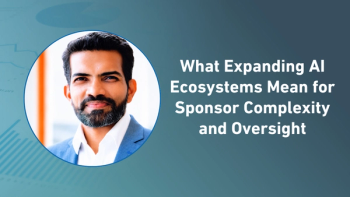
In this video interview, Rajneesh Patil, global head of AI, digital, and innovation in clinical development at Syneos Health, argues that CROs must act as orchestrators rather than aggregators—and that the real test of any AI ecosystem is whether it reduces sponsor coordination burden or just hands it back to them.

Real-time clinical trials require standardized digital data capture at the point of care through scaled eSource-EDC-EHR integration, but progress stalls because competing standards lack regulatory enforcement and one-off system integrations cannot scale beyond single studies without industry-wide alignment and legal clarity on data ownership.
In today’s ACT Brief, we examine why the future of AI in trials is a trusted orchestration system rather than a single model, how coordinators rate eSource-enabled workflows, and what a bipartisan bill proposes for reusable trial networks.

The Faster Clinical Trials Act would create an FDA Center for Clinical Trial Innovation and aims to cut trial costs and enrollment time by at least 30%.
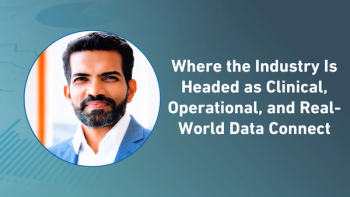
In this video interview, Rajneesh Patil, global head of AI, digital, and innovation in clinical development at Syneos Health, describes the industry’s trajectory toward a unified intelligence orchestration environment—and explains why the future isn’t one model that knows everything, but a trusted system that brings the right evidence to the right human decision.
In today’s ACT Brief, we examine how sites can avoid both fear-driven and overly aggressive AI adoption, why community-based research needs sustained financial investment, and why patient access matters more than organizational size.
Advertisement
Advertisement
Trending on Applied Clinical Trials Online
1
Where the Industry Is Headed as Clinical, Operational, and Real-World Data Connect
2
Building Standardized Evidence for eSource-Enabled Clinical Trials: Multi-Site Validation of a Clinical Research Coordinator Satisfaction Methodology
3
Where AI Governance in Clinical Development Falls Short
4
Bipartisan Bill Would Build Reusable Clinical Trial Networks, With a Focus on Rare Disease
5