

“There are significant changes in NIH funding, which has traditionally funded early clinical programs.”
Commentary|Articles|August 24, 2026
Speed, Discipline, and the New Rules of Biotech Development: Q&A with Stella K. Vnook, PhD, Kaida BioPharma and Aviva Ventures
Listen
0:00 / 0:00
In this Q&A, Stella K. Vnook, PhD, CEO and executive chair of Kaida BioPharma and founder and CEO of Aviva Ventures, discusses how a trifecta of funding pressures is reshaping early-stage clinical development, why commercialization readiness can no longer wait until late-stage, and what a truly strategic lean development model looks like in practice.
Advertisement
A confluence of declining NIH funding, large pharma's pivot toward later-stage assets, and a global operating environment demanding faster, leaner paths to proof-of-concept data is forcing early-stage biotechs to fundamentally rethink how they allocate capital and sequence development decisions.
To explore this further, Applied Clinical Trials spoke with Stella K. Vnook, PhD, CEO and executive chair of Kaida BioPharma and founder and CEO of Aviva Ventures, about which risks are most underappreciated in the current environment, how commercialization strategy is moving upstream into trial design, and what founders should be asking before signing on with an accelerator, incubator, or venture studio.
ACT: How is the current funding environment changing which clinical programs move forward and how sponsors are prioritizing them?
Maybe four years ago, we were much more interested in very creative science and interesting approaches. Now we're focused on going really fast, utilizing less capital to get to inflection points, and getting to first patient in as soon as we can. This trifecta is forcing a much higher level of discipline, rigor, and agility in how we move forward.
ACT: What are the most significant risks facing early-stage and rare disease programs right now?
The most significant risk is not seeing the potential of real assets because we don't have enough funding to get there. The other risk is not selecting the right indication. We now have more analogs and AI models that are allowing us to be smarter in predicting the optimal indication for a mechanism of action. But we still operate on trade-offs—who is the right patient, what is the right endpoint, what is the right trial design. A lot of great assets fall behind because they made the wrong decisions along those paths.
ACT: How has the relationship between commercialization readiness and clinical development strategy shifted?
It doesn't mean you need a full-blown commercial team in pre-clinical or phase one. But it does mean having the right consultants or partners doing the right surveys to understand what the end looks like, so you can create a better, smarter clinical trial design with the right endpoints.
ACT: What does a leaner, more strategic development model actually look like operationally for biotech today?
Instead of hiring a full-blown team as soon as you get seed funding, think about how to use the team fractionally or partner strategically. That has really been a game changer for a lot of companies that have been successful in the past two years.
ACT: Where do you see the greatest strategic opportunities for biotechs willing to adapt their development models?
I'm glad there's more support, but we need to distinguish between branding and substance. An incubator is usually a space with mentoring and early support. An accelerator needs to show it can prove traction; it provides a program and curriculum, maybe investor introductions, and hopefully clinical trial and regulatory experts. A venture studio is a company-building group with real operational expertise and a track record. We need to start asking questions: what have you accelerated, what have you incubated, what are the success stories, what are the exits? A lot of people are using these names as branding, and it can be very confusing for someone who truly needs help.
Advertisement
Related to this article

Mixed FSP and FSO models are gaining ground as sponsors seek agility and resource flexibility, but the oversight infrastructure, audit trails, and accountability structures needed to run them well and survive regulatory inspection are consistently lagging behind the model itself.

Cell and gene therapy access expands into community care settings only when operational coordination, site readiness, and supply chain standardization become first-order priorities equivalent to manufacturing capacity, requiring standardized processes, digital integration, and distributed logistics networks.

AI agents in clinical operations acquire broader autonomous capability through expanded permissions, tools, memory, and delegated authority, requiring governance focused on whether effective capability has shifted outside approved boundaries rather than whether software has changed.

RWE is finding a role earlier in drug development than ever before, but the data quality, integration, and organizational alignment required to make it regulatory-grade are still catching up to the ambition.
Sponsor oversight of outsourced CRO work is often robust in practice but fails inspection because oversight decisions are fragmented across systems and lack an audit trail, requiring sponsors to document oversight as a connected operating system with clear decision records, escalation pathways, and issue resolution from start to finish.
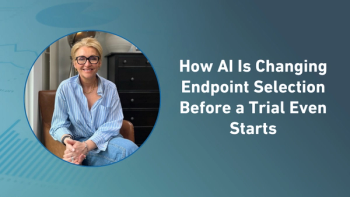
In this video interview, Claire Riches, VP of clinical solutions at Citeline, explains how AI is expanding endpoint selection beyond the bounded experience of a single sponsor team—and surfacing options that traditional design thinking might never have considered.

Most AI pilots in drug development fail not from poor technology but from lack of strategic prioritization, organizational readiness, integrated data infrastructure, and disciplined governance, making success dependent on business discipline rather than technical capability.

Radiopharmaceutical therapy is exposing a broader challenge for clinical development: scientific innovation can advance only as fast as the infrastructure, data, and cross-functional decisions required to deliver it.
Advertisement
Advertisement
Trending on Applied Clinical Trials Online
1
FDA Seeks Public Input on Early-Phase Clinical Trial Design for Ibogaine
2
FDA Releases Transparency Roadmap Outlining Disclosure Priorities Across Drug Development and Regulatory Review
3
Mixed Outsourcing Models Are Spreading. Is Sponsor Oversight Keeping Up?
4
Beyond the Molecule: Why Radiopharmaceutical Trials Require a New Operating Model
5