
“Clinical research is one of the most complex and data-intensive activities in healthcare, yet necessary connections are fragmented all too often.” Sandeep Dadlani, Chief Executive Officer, Optum Insight
News|Articles|October 20, 2026
Syneos Health, Optum Partner on Adaptive Clinical Development Model
Syneos Health and Optum outline a joint model for trial planning, recruitment and site access, with no financial terms or timelines disclosed.
Advertisement
Syneos Health and Optum have announced a partnership to build what they describe as a more adaptive and connected model for clinical development, combining Optum’s healthcare industry knowledge and artificial intelligence (AI) resources with Syneos Health’s trial operations and technology.1 The companies said the model is intended to improve recruitment and trial performance, reduce operational complexity, and make development timelines and costs more predictable.1
The Oct. 20 announcement did not include financial terms, timelines, or performance targets, so it signals direction rather than demonstrated results.1 For sponsors, the practical question is whether pairing a contract research organization with a health services business can change how studies are planned and where they open.
“Clinical development is at an inflection point. The future belongs to organizations that can connect data, human expertise and AI technology to make better decisions faster,” said Costa Panagos, CEO of Syneos Health. “Our collaboration with Optum brings deep healthcare expertise that can help improve trial design and implementation with greater precision and predictability.”1
What will the Syneos Health and Optum partnership cover?
The agreement names three areas of joint development.1 The first is adaptive clinical development planning, which would let teams simulate trial scenarios, evaluate protocol assumptions, identify risks and assess interventions before and during a study.1
The second is access to patients, sites and investigators, intended to help sponsors identify eligible populations and choose locations so trials can begin faster.1 Syneos Health will be Optum’s preferred partner in developing its site management organization.1
The third is data, technology and governance infrastructure meant to scale the work while maintaining standards for scientific validation, privacy, evidence traceability and human oversight.1
Optum, part of UnitedHealth Group, framed the problem as one of fragmentation.1
“Clinical research is one of the most complex and data-intensive activities in healthcare, yet necessary connections are fragmented all too often,” said Sandeep Dadlani, CEO of Optum Insight. “By connecting our responsible use of technology and network with Syneos Health’s global clinical development capabilities, we can make the health system work better for everyone.”1
What does adaptive clinical development mean under FDA guidance?
FDA’s final guidance, issued in December 2019, addresses trials with prospectively planned modifications based on accumulating data. It sets out principles for designing, conducting and reporting such trials, including Bayesian designs and complex designs that rely on computer simulation.2
What does benchmarking say about clinical trial operating models?
Context on operating models comes from a Tufts Center for the Study of Drug Development benchmarking study that Syneos Health announced in September. Across 13 sponsor companies, 81 development programs and 133 trials, no single sourcing model, whether in-house, full-service contract research organization or functional service provider, consistently outperformed the others on timeline, quality or execution.3
A greater number of service providers was associated with longer intervals from protocol approval to database lock, more protocol amendments and more quality events, and with higher dropout rates in some contexts.3 The findings point to operating-model design and coordination across partners, rather than sourcing type, as the stronger influence on performance.3 Tufts conducted the work, but Syneos Health announced it.3
What are the limitations and open questions?
The release names no pilot sponsors, therapeutic areas, enrollment figures or validation data, and it does not describe the AI tools involved.1 Governance commitments appear as principles rather than described mechanisms.1
Earlier performance figures tied to Syneos Health’s AI work, including a reported reduction in the time from source-data capture to review-ready insight from days to hours, were company-reported.4
Open questions remain about how success will be measured against current startup and recruitment timelines, how health data will be used under privacy requirements, and whether adding a second organization to a sponsor’s network of partners will ease or complicate coordination.1
Sources
- Optum and Syneos Health partner to advance an adaptive clinical development model. News release. Syneos Health. October 20, 2026. Accessed October 20, 2026.
https://www.globenewswire.com/news-release/2026/10/20/3384520/33420/en/optum-and-syneos-health-partner-to-advance-an-adaptive-clinical-development-model.html - Adaptive designs for clinical trials of drugs and biologics: guidance for industry. US Food and Drug Administration. December 2019. Accessed October 20, 2026.
https://www.fda.gov/regulatory-information/search-fda-guidance-documents/adaptive-design-clinical-trials-drugs-and-biologics-guidance-industry - Studna A. Benchmarking study finds clinical trial performance is shaped by operating model design, not sourcing strategy. Applied Clinical Trials. September 16, 2026. Accessed October 20, 2026.
https://www.appliedclinicaltrialsonline.com/view/benchmarking-study-finds-clinical-trial-performance-operating-model-design-sourcing-strategy - Syneos Health advances AI-powered clinical ecosystem to optimize trial performance and speed decision-making. News release. Syneos Health. August 18, 2026. Accessed October 20, 2026.
https://www.globenewswire.com/news-release/2026/08/18/3346865/0/en/syneos-health-advances-ai-powered-clinical-ecosystem-to-optimize-trial-performance-and-speed-decision-making.html
Advertisement
Related to this article
In Episode 3 of The Human Side of Clinical Trials, hosts Brian S. McGowan, PhD, FACEHP, chief learning officer and co-founder of ArcheMedX, Inc., and Kelly Ritch, chief operating officer of ArcheMedX, Inc., speak with Jason Riis, PhD, CEO and chief behavioral scientist at Behavioralize, about why a well-written protocol doesn’t always translate into consistent execution, and how designing for the way people actually think and learn can reduce site burden and the need for costly unlearning.

How a phased CRO partnership built on ICH E6(R2) and E6(R3) principles supported a multi-indication biotech portfolio.

Site training effectiveness depends on readiness at first-patient-in, requiring learning-science design principles around performance focus, cognitive load reduction, progressive sequencing, and spaced retrieval practice rather than training completion metrics or content volume.

AstraZeneca and Oracle Outline AI Collaboration for Clinical Trial Recruitment and Safety Monitoring
What sponsors and sites should know about the AstraZeneca-Oracle AI collaboration on trial recruitment, safety monitoring and data governance.
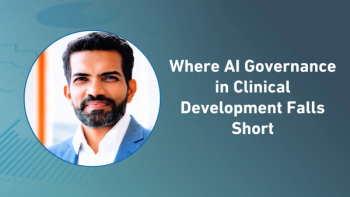
In this video interview, Rajneesh Patil, global head of AI, digital, and innovation in clinical development at Syneos Health, identifies three recurring failure modes in AI governance frameworks—and explains why responsible AI must be an ongoing operating discipline, not a one-time approval gate.
CRIO’s chief innovation officer, Mike Wenger touches on the two ways sites get AI adoption wrong.
CRIO’s Mike Wenger, speaker at this year's SCRS summit, maps how sites are actually deploying AI post-pilot stage.
In this video interview, Rajneesh Patil, global head of AI, digital, and innovation in clinical development at Syneos Health, explains why the real advantage of faster data isn’t speed—it’s shortening the distance between signals, human judgment, and the next best action.
Advertisement
Advertisement
Trending on Applied Clinical Trials Online
1
Where AI Governance in Clinical Development Falls Short
2
2026 SCRS Global Site Solutions Summit: What's the Biggest Mistake Sites or Sponsors Make When Implementing Advanced Al?
3
How Compressing Time From Data Capture to Insight Changes Trial Risk Management
4
Endpoints That Reflect What Patients Actually Value: Who Decides What Counts as Trial Success
5