Register Now - Beyond Recruitment: The Future of Patient Site Engagement in Oncology Clinical Trials
Commentary|Videos|July 29, 2026

What Needs to Be True for the FDA's Real-Time Pilot Model to Work Beyond Big Pharma

In this video interview, Raviv Pryluk, CEO and co-founder of PhaseV, explains why the FDA's real-time clinical trial pilot was promising but not yet scale ready—and what technology infrastructure needs to be in place for the model to work broadly.

Full interview summary

In a recent video interview with Applied Clinical Trials, Raviv Pryluk, CEO and co-founder of PhaseV, discussed the "dead time" problem in clinical data—the gap between when data is measured and when it is clean enough to analyze—and what it will actually take to make real-time trial monitoring a practical reality at scale. He opened by framing the core challenge: the data collection, cleaning, validation, and standardization processes that stand between raw trial data and analysis-ready data create delays that undermine the promise of continuous oversight, unless the right technologies are in place to compress or eliminate that gap.

Pryluk described how data flowing into clinical trials from central labs, CRA queries, EDC systems, and CTMS arrives in formats that require substantial transformation before it meets standards like ADAM and STDM. Until recently, that transformation required weeks of manual work from statistical programmers. The emergence of LLMs and AI-driven tools is changing that, enabling the kind of near-automated standardization that is a prerequisite for real-time monitoring at scale. At the same time, he acknowledged a tension sponsors are actively raising: the risk of surfacing false signals from data that hasn't been properly cleaned. Balancing speed with rigor, he argued, is the central challenge.

On the FDA's real-time pilot with two large pharma companies, Pryluk was measured—acknowledging it as a meaningful step while noting that even at that scale, the work was not yet scale ready. The enabler that could change that is the same LLM-driven capability that is beginning to automate ADAM and STDM generation. He stressed that scaling this model will require an ecosystem approach, bringing together regulators, sponsors, CROs, and technology vendors in a transparent, shared-learning environment rather than allowing learnings to remain siloed within individual companies. He closed by emphasizing the importance of quick wins and a gradual rollout across phases and therapeutic areas to build confidence and maintain momentum.


Related to this article

Closing the Community Access Gap: Q&A with Kent Thoelke, Paradigm Health
In this Q&A, Kent Thoelke, CEO of Paradigm Health, discusses why participation gaps in community and rural settings come down to both patient cost barriers and site infrastructure, how legacy workflows weigh on community clinics, and what policy and technology changes it would take to make clinical research a real care option for more patients.
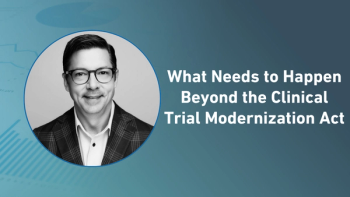
What Needs to Happen Beyond the Clinical Trial Modernization Act
In this video interview, Kent Thoelke, CEO of Paradigm Health, calls for safe harbor protections, CMS reimbursement safeguards, and funding mechanisms modeled on EHR meaningful use to help community and rural institutions participate in research on par with academic centers.
Building AI Assistants Clinical Trial Teams Can Trust: Q&A with E.K. Koh, Suvoda
In this Q&A, E.K. Koh, chief product officer at Suvoda, discusses what separates a trustworthy AI assistant from one that adds risk, why curated clinical knowledge matters more than general-purpose flexibility, and what safeguards must be in place when assistants move from answering questions to taking actions in clinical trial systems.