Register Now - Beyond Recruitment: The Future of Patient Site Engagement in Oncology Clinical Trials
|Webcasts|April 5, 2021

RBM Case Studies: AI-ML Implementation and Shifts in Clinical Operating Models – Defining monitoring of the future

Author(s)IQVIA

*** Monday, April 5, 2021 at 11am EDT *** Risk-based monitoring (RBM) continues to evolve and adapt to industry needs. Understand how innovative technologies and methodologies are driving new levels of study quality and changing clinical monitoring and how artificial intelligence, machine learning, predictive and advanced analytics are improving patient safety and overall study quality and operational efficiencies. ***On demand available after final airing until Apr. 5, 2022***

Register free: http://www.appliedclinicaltrialsonline.com/act_w/study_quality

​Event Overview:

  • Highlight the adoption and implementation trends in risk based monitoring models as a key mitigation strategy during and post pandemic
  • Share learnings from practical models using predictive and advanced analytics help reduce white noise/false positives in signal detection deployed for RBM
  • Provide insights on where machine learning and artificial intelligence models have potential application in clinical monitoring to address risks based on study design and patient population

Register now to hear the latest capabilities that are changing how clinical trials are being delivered with better, more timely patient insights enhancing patient safety and improving overall study quality.

3 Key take-aways:

  • Realize the impact RBM can have on study quality, patient safety and cost of clinical trial conduct while pivoting to remote monitoring strategies to mitigate site accessibility issues from pandemic
  • Understand how innovative technologies and methodologies are driving new levels of study quality and changing clinical monitoring within a variety of operational services—from study delivery to enterprise solutions
  • Hear how artificial intelligence, machine learning, predictive and advanced analytics are improving patient safety and overall study quality and operational efficiencies

Speakers: Dr Rajneesh Patil, Vice President, Clinical Operations, IQVIA

Michael Jones, Vice President, Clinical FSP Solutions Client Engagement, IQVIA

Time and Date: Monday, April 5, 2021 at 11am EDT

On demand available after final airing until Apr. 5, 2022

Register free: http://www.appliedclinicaltrialsonline.com/act_w/study_quality


Related to this article

Closing the Community Access Gap: Q&A with Kent Thoelke, Paradigm Health
In this Q&A, Kent Thoelke, CEO of Paradigm Health, discusses why participation gaps in community and rural settings come down to both patient cost barriers and site infrastructure, how legacy workflows weigh on community clinics, and what policy and technology changes it would take to make clinical research a real care option for more patients.
© Grispb - © Grispb - stock.adobe.com
Mistral and OpenAI produced identical overall eligibility labels across 200 synthetic patient-study assessments, with criterion-level disagreements concentrated in inclusion criteria where models switch between “Uncertain” and “Not included” when records lack sufficient evidence, so model choice should be driven by deployment architecture, control, and cost rather than assumed interchangeability.
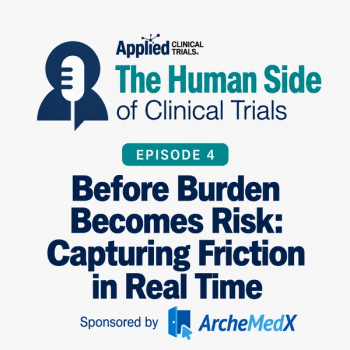
The Human Side of Clinical Trials: Before Burden Becomes Risk, Capturing Friction in Real Time
In Episode 4 of The Human Side of Clinical Trials, host Brian S. McGowan, PhD, FACEHP, chief learning officer and co-founder of ArcheMedX, Inc., speaks with Jason Riis, PhD, CEO and chief behavioral scientist at Behavioralize, about how capturing friction closer to the moment it happens can reveal unclear instructions, technology friction, and workarounds that retrospective surveys and debriefs tend to miss.