



Data Management
Latest News

Lessons from Hundreds of Clinical Trials: AI’s Successes, Gaps, and Opportunities
Advertisement
Latest Videos

Shorts

0:51
Bringing Together Modern Infrastructure to Meet New FDA Standards
3 months ago
by
Raj Indupuri(+1 more)
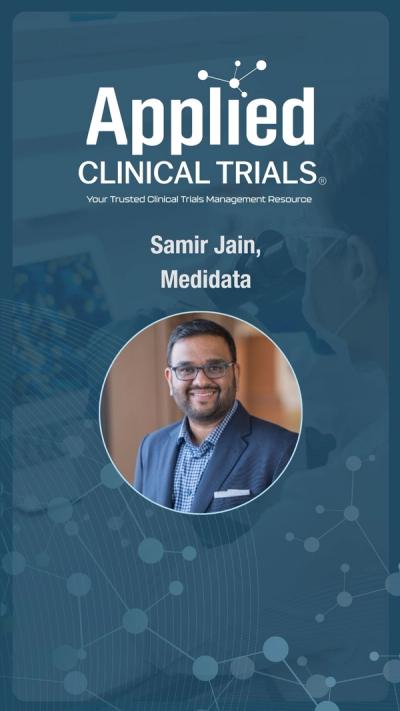
0:46
A Hidden Cost in Clinical Trials: 20% Wasted on Manual Data?
4 months ago
by
Samir Jain
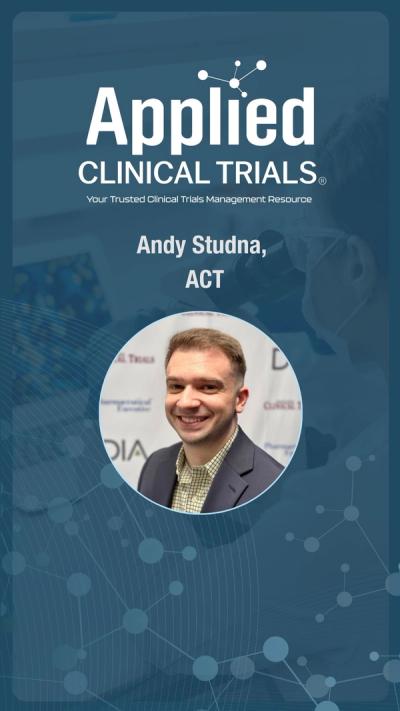
1:26
ACT Ops Take: Reshaping Clinical Trials with Real-World Data
5 months ago
by
Andy Studna, Senior Editor
1:27
ACT Ops Take: Modernizing Participant Payments for Clinical Trial Success
5 months ago
by
Andy Studna, Senior Editor
0:30
Why Data Doesn't Speak For Itself Anymore
6 months ago
by
Marc Buyse(+1 more)
0:54
The 3 Keys to Successful Digital Measure Integration
6 months ago
by
Jeremy Wyatt(+1 more)
0:34
The Different Flavors of eSource
7 months ago
by
Mike Wenger(+1 more)
0:34
Integrating Anonymized Data into Clinical Development
8 months ago
by
Jen Lamppa(+1 more)
0:47
The New Era of Clinical Trial Oversight: Leveraging Data for Site Selection
10 months ago
by
Matt Holms(+1 more)
0:51
The Three Elements of Efficient Clinical Data Management
10 months ago
by
Ben Edwards(+1 more)
Advertisement
More News
Advertisement

Clinical trials have spent decades perfecting data capture, but the execution layer underneath it, including decision workflows, data collection design, and lab connectivity, remains fragmented in ways that limit what AI can realistically deliver and that quietly compromise the scientific validity of the data itself.

Participant engagement depends more on clarity and understanding than on gamification or incentives, requiring engagement embedded into trial workflows as a core design component rather than a peripheral consideration

Biomarker-informed trial enrollment appears straightforward for identifying responders and optimizing efficiency, but failures to account for demographic variation in cut-off selection, causality versus correlation, and composite biomarker complexity risk excluding viable patients and exacerbating disparities.

Agentic AI will put the CRO operating model to the test—and force the efficiency and accountability questions the industry can no longer avoid.

How to generate reliable Phase I evidence in a capital-constrained environment.

In this Q&A, Raviv Pryluk, PhD, CEO and co-founder of PhaseV, discusses the data standardization bottleneck that sits between raw trial data and real-time analysis, what the FDA's continuous monitoring pilot will require to scale beyond large pharma, and why an ecosystem approach is the only path to making real-time trial oversight a practical reality.

Clinical research associates are evolving from compliance-focused manual monitors to data-enabled strategic site partners, but organizations need analytics training, clear operating models, and active change management to make the shift stick.

From point-of-care sample collection to real-world data curation, wearable device integration, and continuous review infrastructure, data quality is not a single problem in clinical trials—it is a layered challenge that manifests differently at every stage of development and demands a different set of solutions at each one.

In this Q&A, Richard Graham, PhD, co-founder and chairman of the board at TruTechnologies, discusses why six decades of manual site-level processes continue to undermine clinical trial execution, what national initiatives like Operation TrialBlazer leave unaddressed, and why meaningful modernization has to start with data collected at the point of care.
Real-time AI-enabled decision-making only accelerates development when trials have coordinated operational infrastructure for randomization, supply management, and workflows capable of responding to new insights without disrupting execution or compliance.
Advertisement

Real-world oncology data requires hybrid curation combining clinical expertise with technology to address variability in documentation, missing data, and complex concepts like lines of therapy that are often implicit rather than explicitly recorded in EHRs.

Consumer-grade wearables offer promise for reducing trial burden and improving engagement, but accuracy and reliability vary substantially by device, measurement, and population, requiring rigorous fit-for-purpose validation and careful endpoint selection before integration into regulated research.

As agentic AI, automated data harmonization, and real-time monitoring reshape clinical development, the organizations seeing meaningful results are those that have invested in unified data infrastructure and disciplined governance rather than cycling through pilots without the foundation to scale them.

Clinical development operates as an integrated system where dependencies persist across phases and vendors, but treating contracts as execution handoffs creates invisible oversight gaps that surface later as vendor performance problems, timeline slips, or inspection findings.

The European Health Data Space reshapes CRO operations by transitioning them from data custodians to regulated users accessing data within secure, auditable environments, enabling cross-border research but requiring substantial investment in compliance, standardization, and methodological rigor.
Phase III oncology setbacks often reflect incomplete biological understanding rather than target failures, but robust biomarker strategy and multi-dimensional patient selection developed early in development can strengthen pivotal trial design and increase success.
The traditional global-to-local communication model creates fragmented content through sequential adaptation, but a local-first approach using structured data and AI-orchestrated generation can embed stakeholder terminology and preferences from the start, reducing rework while improving clarity and relevance.

In this Q&A, Rob DiCicco, vice president of portfolio management at TransCelerate Biopharma, discusses the collaborative work underway with FDA and CTTI to explore selective safety data collection as a model for de-risking trial design, reducing site and patient burden, and scaling pragmatic trial approaches across the industry.

In this Q&A, Liz Beatty, co-founder and chief strategy officer at Inato, discusses how real-time patient data is reducing non-enrolling sites, why sponsor-specific technology remains the biggest barrier to adoption, and what a shift toward cross-asset site partnerships could mean for enrollment efficiency.

In this video interview, Rob DiCicco, vice president of portfolio management at TransCelerate Biopharma, looks ahead to how simplification built through selective safety data collection could ease broader trial operations and help address a shrinking investigator pool.
In this video interview, Rob DiCicco, vice president of portfolio management at TransCelerate Biopharma, explains why scaling pragmatic and decentralized trial approaches, not just piloting them once, is where the real reduction in cost and burden happens.
In this video interview, Rob DiCicco, vice president of portfolio management at TransCelerate Biopharma, breaks down CTTI research showing 50 to 75% reductions in visits and assessments using selective safety data collection, and why mature assets make this approach safe to use.

In this video interview, Rob DiCicco, vice president of portfolio management at TransCelerate Biopharma, explains how four jointly developed regulatory scenarios give sponsors a blueprint for adopting selective safety data collection with greater confidence and stronger agency alignment.

The FDA's launch of real-time clinical trial proof-of-concept studies signals a fundamental shift in regulatory oversight, one that most sponsors are not yet equipped to meet and that demands urgent investment in unified data infrastructure, quality-by-design practices, and protocol digitization.

Clinical data security built into system architecture from the foundation, rather than layered on afterward, reduces regulatory risk and actually accelerates research by removing manual compliance burden and improving team confidence in data integrity.
Advertisement
Advertisement
Trending on Applied Clinical Trials Online
1
Moving Beyond Disappointing Pilots: Scaling Adoption of AI-Enablement in Drug Development
2
Is Decentralization Actually Reducing Site Burden, or Just Moving It?
3
DPHARM 2026: What the Patient-Site Relationship Needs Most Right Now
4
ACT Brief: Patient-Site Interaction and Technology, AI Pilot Success Requires Discipline, and CagriSema Beats Lilly Drug
5