


Regulators on both sides of the Atlantic have taken action against Tavneos after an FDA investigation found patient outcome data was altered and trial personnel were unblinded during the pivotal study that supported the drug's approval.
Regulators on both sides of the Atlantic have taken action against Tavneos after an FDA investigation found patient outcome data was altered and trial personnel were unblinded during the pivotal study that supported the drug's approval.
In today's ACT Brief, we examine what the FDA's real-time oversight initiative demands of sponsors, why clinical data security must be designed in rather than layered on, and how AI is reshaping CDMO workflows and asset value.

The FDA's launch of real-time clinical trial proof-of-concept studies signals a fundamental shift in regulatory oversight, one that most sponsors are not yet equipped to meet and that demands urgent investment in unified data infrastructure, quality-by-design practices, and protocol digitization.
In today's ACT Brief, we recap key themes from DIA 2026 on operational priorities and regulatory shifts, examine infrastructure gaps in continuous data review, and report on EMA support for a new BTK inhibitor strategy.

In this Q&A, Raj Indupuri, CEO and co-founder of eClinical Solutions, discusses what the FDA's push toward continuous data review actually demands of sponsors operationally, why fragmented systems are the core obstacle, and how AI and real-world evidence fit into a more data-driven regulatory environment.

From real-time evidence generation to federated AI to site-level data integration, ACT spoke with seven experts at DIA 2026 on the trends and challenges defining clinical trial operations today.
In today's ACT Brief, we examine integrating site and sponsor data systems, a high-profile trial retraction over integrity concerns, and a new first-line breast cancer treatment.

A Phase III trial linking morning administration of immunochemotherapy to dramatically better survival outcomes in non-small cell lung cancer has been pulled over concerns about data integrity, protocol inconsistencies, and unexpected findings.
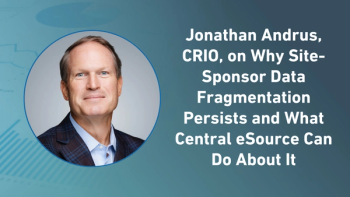
In this video interview following the 2026 DIA Global Annual Meeting, Jonathan Andrus, co-CEO of CRIO, explains why integrating site-level data systems with sponsor oversight has remained so difficult, what a central eSource model requires to work for all stakeholders, and why the industry needs to stop waiting for perfection and start taking the step.
In today's ACT Brief, we examine regulatory uncertainty and 2026 breakthroughs shaping clinical research, reimagining CRO contracting models for financial transparency, and Eli Lilly's acquisition strategy.
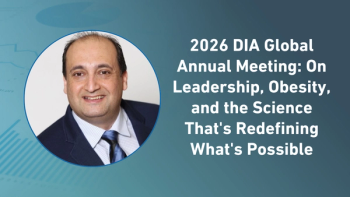
In this video interview, Marwan Fathallah, president and CEO of DIA Global, makes the case for ecosystem-wide leadership in a time of regulatory uncertainty and highlights the breakthroughs in obesity, healthcare AI, and cell and gene therapy that have most excited him in 2026.
In today's ACT Brief, we examine HHS coordinated effort to restore US clinical research leadership, two decades of rising protocol complexity, and data architecture frameworks for AI sustainability.
A coordinated department-wide initiative combines FDA regulatory reforms, NIH investments, and new agency programs to reduce development timelines and reverse a growing shift of clinical research overseas.
In today's ACT Brief, we examine a major CRO-tech partnership scaling agentic AI, operational challenges sites face with decentralized trials, and AI-driven CNS drug discovery collaboration.

In this video interview from the 2026 DIA Global Annual Meeting, Nick Scott of Biogen and Samantha Hadfield of Thermo Fisher Scientific, discuss where mixed outsourcing models deliver the greatest gains in efficiency and agility, and why a deliberate, partnership-first approach is what separates successful implementations from ones that struggle.
In this video interview from the 2026 DIA Global Annual Meeting, Joan Chambers, independent senior consultant at Tufts CSDD, examines the operational challenges sites face when implementing DCT components and makes the case that the industry is still in a learning phase—one the data will ultimately need to guide.

The enterprise-wide partnership brings Microsoft 365 Copilot, Azure, and Fabric infrastructure to ICON's Orbis platform, supporting AI deployment across study design, site operations, and regulatory workflows.
In today's ACT Brief, we examine mixed FSP models as strategic agility tools, key themes from the 2026 DIA Global Annual Meeting, and federated AI expanding oncology research.
In this video interview from the 2026 DIA Global Annual Meeting, Angie Maurer, VP of AI-enabled clinical development at Medable, describes how digitizing protocols transforms manual amendment workflows into automated, AI-orchestrated processes—and why structured data from the start is the foundation the FDA's continuous review model depends on.

In this video interview from the 2026 DIA Global Annual Meeting, Stacy Hurt, chief patient officer at Parexel, explains how federated AI is expanding what's possible in oncology research, why the patient voice gets lost earliest in development, and why someone in every organization needs to explicitly own patient needs from the very beginning.
In today's ACT Brief, we examine real-time evidence generation priorities, automating protocol digitization, and fit-for-purpose decentralized trial deployment.
In this video interview, Marwan Fathallah, president and CEO of DIA Global, shares the key trends and themes shaping this year's meeting—from AI and regulatory uncertainty to the exploding innovation coming out of the global biotech and medtech ecosystem.

In this video interview from the 2026 DIA Global Annual Meeting, Nick Scott of Biogen and Samantha Hadfield of Thermo Fisher Scientific, explain why mixed FSP models are becoming a strategic tool for sponsors seeking greater agility and how geography and portfolio structure shape the decision.
In this video interview from the 2026 DIA Global Annual Meeting, Joan Chambers, independent senior consultant at Tufts CSDD, explains how the flexibility and accessibility of decentralized trial modalities are expanding patient reach—and why fit-for-purpose deployment is key to making them work.
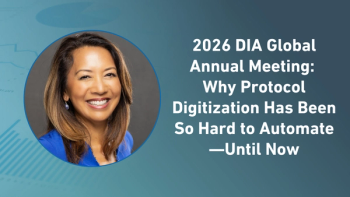
In this video interview from the 2026 DIA Global Annual Meeting, Angie Maurer, VP of AI-enabled clinical development at Medable, explains the three structural barriers that kept protocol digitization out of reach and why the convergence of LLMs, industry standards, and validated environments has finally changed the equation.
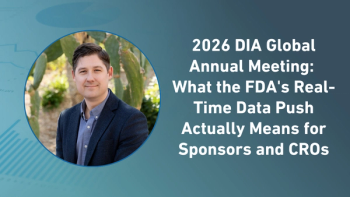
In this video interview from the 2026 DIA Global Annual Meeting, Kevin Bugin, head of global regulatory policy and intelligence at Amgen and executive sponsor of TransCelerate's Embedded Pragmatic Trials initiative, reframes the FDA's continuous review expectations around real-time evidence generation and explains why quality by design—not data cleanup—is what regulators are now demanding.
In today's ACT Brief, we examine building infrastructure for real-time clinical and real-world data integration, modernizing participant payments to reduce dropout, and a Phase III confirmatory trial failure for a lung cancer drug.
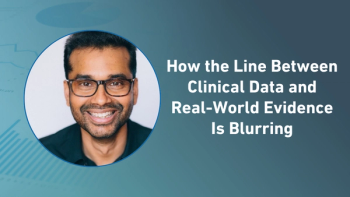
In this video interview, Raj Indupuri, CEO and co-founder of eClinical Solutions, explains why organizations that build infrastructure capable of harmonizing clinical and real-world data in real time will be best positioned for the continuous, data-driven regulatory environment now emerging.
In today's ACT Brief, we examine quantified returns on RBQM implementation, why allowing sponsors to control AI governance builds adoption, and how basket trials reshape rare pediatric oncology development.
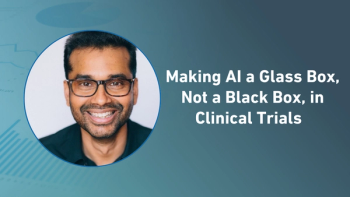
In this video interview, Raj Indupuri, CEO and co-founder of eClinical Solutions, describes how giving sponsors the ability to inject their own SOPs, protocols, and governance frameworks into AI systems is the key to building the trust needed for real-world adoption.