



Technology
Latest News
Advertisement
Latest Videos
Advertisement
More News
Advertisement

Unclear boundaries between investigator-controlled and sponsor-managed data in IRT systems are creating avoidable compliance risk, particularly around investigational product inventory and quality actions.
Learn why combining AI-enabled trial matching with transportation, lodging, and financial assistance is essential to turning trial eligibility into actual participation—and why matching alone is not enough.
Examine how the American Cancer Society’s national ACTS expansion is designed to simplify trial discovery, reduce logistical barriers, and help patients, caregivers, and providers navigate cancer clinical trials through a centralized support model.
Learn how AI-enabled automation can streamline existing operational processes, reduce manual effort, and enhance efficiency while allowing sites to work as they do today.

New research finds that while eSource adoption is advancing through EHR-to-EDC workflows, scaling its impact will depend on integrating unstructured clinical data using AI, shared standards, and collaborative validation models across sites, sponsors, and vendors.
Learn how clinical operations leaders can build technology adoption, transform workflows, and cultivate digitally savvy talent to successfully implement AI across the entire clinical trial lifecycle.
Discover how remote assessments, wearables, and digital technologies can decentralize data collection, reduce patient burden, and enable trials to reach more diverse and representative populations.

New data show that applying AI to the migration of translated COAs into eCOA platforms can meaningfully reduce errors, accelerate localization workflows, and support broader global patient participation—while still relying on human reviewers to ensure linguistic precision and clinical integrity.

See how combining human oversight with AI insights improves protocol authorship, site selection, and monitoring strategies, delivering better decisions than AI-only or human-only approaches.
Explore how AI can optimize study design, speed patient recruitment, and streamline operational workflows to shorten development timelines and enhance trial efficiency.
Advertisement

Strong relational governance between technology vendors and sponsor–CRO teams is becoming a critical foundation for eCOA trial success, enabling faster study launches, clearer communication, proactive issue management, and sustained quality across entire trial portfolios.

AI-driven discovery, EHR-based real-world evidence, and synthetic patient modeling are rapidly reshaping drug repurposing, reducing development timelines, expanding therapeutic applications, and accelerating regulatory acceptance of computational approaches.
Explore the drivers behind increased investment in CNS and autoimmune trials, including pain, mental health, and inflammatory conditions, and see how technology, decentralized trials, and hybrid designs are shaping study operations.

The FDA has introduced a secure, agency-wide agentic AI system to support complex regulatory workflows—enhancing reviews, surveillance, and inspections—while maintaining strict data protections and human oversight.

As clinical trials become more complex and decentralized, the role of the CRA is evolving from site monitor to strategic, digitally fluent partner, requiring expertise in hybrid oversight, risk-based monitoring, and multi-system data management.

As AI adoption accelerates across clinical research, clear distinctions between AI agents, AI teammates, and integrated intelligence are essential for understanding how automation will reshape site operations, workforce roles, and end-to-end study processes.

AI-enabled automation is rapidly moving into routine pharmacovigilance operations, streamlining case intake and processing, reducing longstanding adoption barriers, and driving new efficiencies as sponsors and functional service provider partners scale safety workflows.

A new global Tufts CSDD survey of 387 investigative site professionals reveals broad experience with digital and decentralized trial tools, growing site-driven technology investments, and strong support for remote data collection—while highlighting persistent burdens tied to fragmented systems, training demands, and financial strain.
Explore methods to evaluate recruitment performance across multiple platforms, including engagement tracking, conversion analysis, and data-driven optimization for emerging digital spaces.
Examine real-world examples of patient engagement through less conventional channels and see how targeted campaigns can reach high-quality participants even in low-volume or emerging platforms.

Emerging applications of AI/ML, automation, and digitization are helping sponsors cut clinical trial start-up times to as little as four weeks, reduce data errors, and enhance patient engagement—demonstrating how tech-enabled processes are reshaping trial efficiency and experience across the study lifecycle.
Understand the regulatory and policy considerations for running clinical trial recruitment campaigns on nontraditional or entertainment-focused platforms, and how ongoing collaboration with ad teams ensures compliant, effective outreach.
Learn how demographic and behavioral insights inform platform-specific messaging, creative formats, and call-to-action strategies to engage patients and caregivers effectively across diverse digital channels.
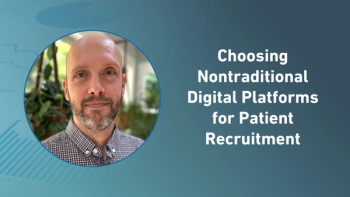
Explore which factors—audience relevance, content fit, and engagement quality—determine the best use of platforms like TikTok, Reddit, and Spotify for targeted patient recruitment campaigns.
Leveraging real-world data and AI-driven insights in clinical trial planning can reduce enrollment failures, improve retention, and prevent costly rescue studies by providing a more accurate view of patient populations and site feasibility.
Advertisement
Advertisement
Trending on Applied Clinical Trials Online
1
FDA Seeks Public Input on Early-Phase Clinical Trial Design for Ibogaine
2
FDA Releases Transparency Roadmap Outlining Disclosure Priorities Across Drug Development and Regulatory Review
3
Mixed Outsourcing Models Are Spreading. Is Sponsor Oversight Keeping Up?
4
Beyond the Molecule: Why Radiopharmaceutical Trials Require a New Operating Model
5